
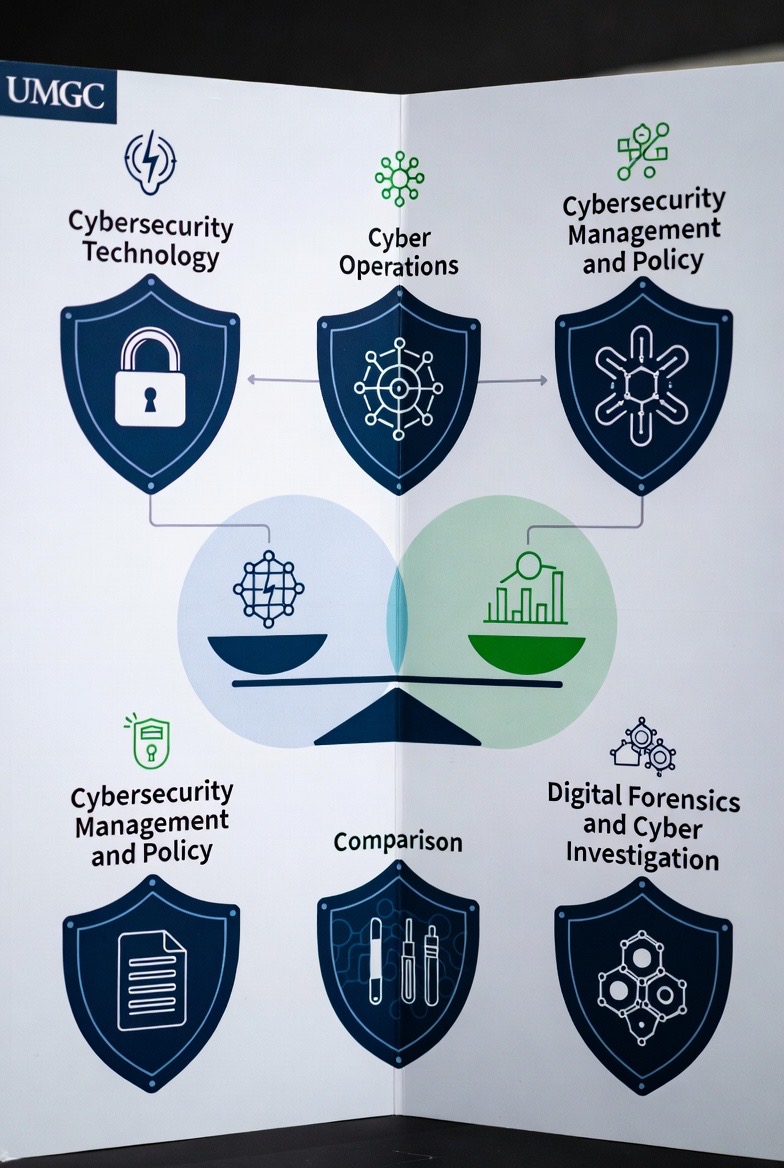
The University of Maryland Global Campus (UMGC) offers three distinct master's degree programs in cybersecurity, each designed to prepare students for different career trajectories in this rapidly growing field. Understanding the differences between these programs is crucial for making an informed decision about your educational investment and career future.
The Three Programs: An Overview
UMGC's cybersecurity master's programs are:
- Master of Science in Cybersecurity Technology
- Master of Science in Cyber Operations
- Master of Science in Cybersecurity Management and Policy
While all three programs share a foundation in cybersecurity principles, they diverge significantly in their focus areas, technical depth, and target career paths. Let's examine each program in detail.
Master of Science in Cybersecurity Technology
Program Focus
This program emphasizes the technical and engineering aspects of cybersecurity. It's designed for students who want to become hands-on security practitioners, developing and implementing security solutions at the infrastructure and application levels.
Core Curriculum
The Cybersecurity Technology program delves deep into:
- Network security architecture and design
- Security software development and secure coding practices
- Cryptography and cryptanalysis
- Database security and secure data management
- Cloud security implementation
- Security testing and vulnerability assessment
- Digital forensics and incident response
Ideal Candidate Profile
This program suits individuals with a strong technical background who enjoy problem-solving through code and system design. You should be comfortable with programming languages, networking concepts, and system administration. Many students in this track have backgrounds in software development, network engineering, or IT administration.
Career Outcomes
Graduates typically pursue roles such as:
- Security Engineer
- Application Security Engineer
- Security Architect
- Cloud Security Engineer
- Penetration Tester
- Security Software Developer
Average salary range: $95,000 - $160,000 depending on experience and location.
Master of Science in Cyber Operations
Program Focus
The Cyber Operations program takes a more offensive and defensive tactical approach. It prepares students for roles that involve active threat hunting, incident response, and security operations center (SOC) leadership.
Core Curriculum
Key areas of study include:
- Offensive security and ethical hacking
- Defensive cybersecurity operations
- Threat intelligence and analysis
- Malware analysis and reverse engineering
- Security operations center (SOC) management
- Incident response and forensics
- Network traffic analysis
- Advanced persistent threat (APT) detection
Ideal Candidate Profile
This program is perfect for those who thrive in high-pressure, fast-paced environments and have a strong interest in the cat-and-mouse game between attackers and defenders. Students should have foundational knowledge of networking, operating systems, and security principles. Many come from backgrounds in IT support, system administration, or junior security analyst roles.
Career Outcomes
Graduates often move into positions like:
- SOC Analyst (Tier 2/3)
- Incident Response Analyst
- Threat Hunter
- Security Operations Manager
- Malware Analyst
- Red Team Operator
- Cyber Intelligence Analyst
Average salary range: $90,000 - $155,000 depending on experience and sector (government roles may differ).
Master of Science in Cybersecurity Management and Policy
Program Focus
This program bridges the gap between technical cybersecurity knowledge and business leadership. It's designed for those who want to lead cybersecurity initiatives from a strategic, managerial, or policy-making perspective rather than implementing technical solutions directly.
Core Curriculum
The curriculum covers:
- Cybersecurity risk management
- Governance, risk, and compliance (GRC)
- Security policy development and implementation
- Business continuity and disaster recovery planning
- Legal and ethical aspects of cybersecurity
- Security program management
- Cybersecurity leadership and team building
- Budget management for security initiatives
Ideal Candidate Profile
This program attracts professionals who have some technical background but are more interested in the strategic, managerial, and policy aspects of cybersecurity. You should enjoy working with people, developing organizational strategies, and navigating complex regulatory requirements. Many students have backgrounds in IT management, project management, or are technical professionals looking to transition into leadership roles.
Career Outcomes
Graduates typically advance to roles including:
- Chief Information Security Officer (CISO)
- Cybersecurity Manager/Director
- GRC Analyst/Manager
- Security Compliance Manager
- IT Risk Manager
- Security Program Manager
- Cybersecurity Consultant
Average salary range: $100,000 - $180,000+ (CISO roles in large organizations can exceed $200,000).
Key Differences at a Glance
| Aspect | Technology | Operations | Management & Policy |
|---|---|---|---|
| Primary Focus | Building secure systems | Defending against threats | Leading security initiatives |
| Technical Depth | Very High | High | Moderate |
| Programming Required | Extensive | Moderate | Minimal |
| Management Focus | Low | Moderate | High |
| Best For | Builders & Engineers | Defenders & Analysts | Leaders & Strategists |
Career Advice: Choosing the Right Program
Choose Cybersecurity Technology If You:
- Have a strong programming background or want to develop one
- Enjoy designing and building security solutions from scratch
- Want to work on cutting-edge security technologies
- Prefer hands-on technical work over meetings and documentation
- See yourself as a security architect or principal engineer
Choose Cyber Operations If You:
- Thrive in high-pressure, tactical situations
- Are fascinated by threat actors and attack techniques
- Want to be on the front lines of cybersecurity defense
- Enjoy the challenge of outsmarting adversaries
- See yourself leading a SOC or incident response team
Choose Cybersecurity Management and Policy If You:
- Have or aspire to leadership positions
- Enjoy strategic planning and organizational change
- Are interested in compliance, governance, and risk management
- Want to influence security at an organizational or policy level
- See yourself as a CISO or security director
Additional Considerations
Prerequisites and Preparation
All three programs require a bachelor's degree, though not necessarily in a technical field. However, the Technology and Operations programs strongly benefit from prior technical experience. If you're coming from a non-technical background, consider taking foundational courses in networking, operating systems, and basic programming before starting these programs.
Certifications
UMGC's programs align well with industry certifications:
- Technology: CISSP, CSSLP, CEH, OSCP
- Operations: GCIH, GCIA, GNFA, CEH, OSCP
- Management & Policy: CISSP, CISM, CRISC, CGRC
Time Commitment and Flexibility
All three programs are designed for working professionals and offer online formats. The typical completion time is 20-24 months for full-time students, though part-time options are available. UMGC's asynchronous format allows you to balance work, life, and education effectively.
The Bottom Line
Your choice among UMGC's three cybersecurity master's programs should align with your career goals, technical aptitude, and work preferences. The Technology program is ideal for those who want to build security solutions, the Operations program suits those who want to defend against active threats, and the Management and Policy program is perfect for aspiring security leaders.
Consider your long-term career vision: Do you see yourself writing security code, responding to incidents in a SOC, or leading an organization's security strategy? Your answer will guide you to the right program.
Whichever path you choose, UMGC's reputation for quality online education and its focus on practical, career-relevant skills make any of these programs a solid investment in your cybersecurity future.
Sources
- UMGC MS in Cybersecurity Technology Program Page
- UMGC MS in Cyber Operations Program Page
- UMGC MS in Cybersecurity Management and Policy Program Page
- Bureau of Labor Statistics, Occupational Outlook Handbook - Information Security Analysts
- PayScale Salary Data for Cybersecurity Professionals (2025)