I've been exploring decentralized domains for a while now, and HNS.id has caught my attention as one of the more user-friendly ways to enter the Handshake ecosystem. After spending time testing the platform with domains like agi.wallet and defai.wallet, I wanted to share my hands-on experience for anyone curious about Web3 domains but unsure where to start.
What Is HNS.id and How Does It Work?
HNS.id is a decentralized domain marketplace built on top of the Handshake blockchain. Think of it as a bridge between traditional domain registrars and the decentralized web. Instead of going through ICANN-controlled systems like .com or .net, Handshake creates a parallel naming system where top-level domains (TLDs) are owned and traded as blockchain assets.

The platform works like this: you connect your Web3 wallet (MetaMask, for example), search for available domains under various TLDs like .wallet, .hns, or .uwuai, and purchase them using cryptocurrency. These domains are then stored as NFTs in your wallet, giving you true ownership without any intermediary who can revoke your registration.
What makes HNS.id different from other Handshake platforms is its focus on simplicity. You don't need to run a Handshake node or understand the technical complexities of the blockchain. The interface is clean, mobile-friendly, and handles the blockchain interactions for you.
Why Decentralized Domains Matter in Web3 and AI
When I first heard about Handshake domains, I was skeptical. Why do we need another domain system? But after using them, I see the appeal, especially as we move toward a more AI-driven internet.
Traditional domains rely on centralized authorities. Your domain can be seized, suspended, or censored by registrars, governments, or corporations. With Handshake domains, you hold the private keys. No one can take your domain away without your permission. This is particularly valuable for controversial projects, privacy-focused services, or anyone operating in jurisdictions with unpredictable regulations.
For AI and Web3 applications, decentralized domains offer several advantages:
- Wallet addresses: Instead of sharing long, complex wallet addresses, you can use human-readable names like agi.wallet or defai.wallet
- Persistent identity: AI agents and smart contracts can reference stable, censorship-resistant identifiers
- Data sovereignty: You control the records, redirects, and content associated with your domain
- Future compatibility: As decentralized protocols mature, Handshake domains may become standard for Web3 services
That said, adoption is still early. Most browsers don't natively resolve Handshake domains, which means you need browser extensions or special resolvers. This limits mainstream usability for now.
How to Connect MetaMask to HNS.id
Getting started with HNS.id requires a Web3 wallet. I used MetaMask since it's the most popular option and works seamlessly with the platform.
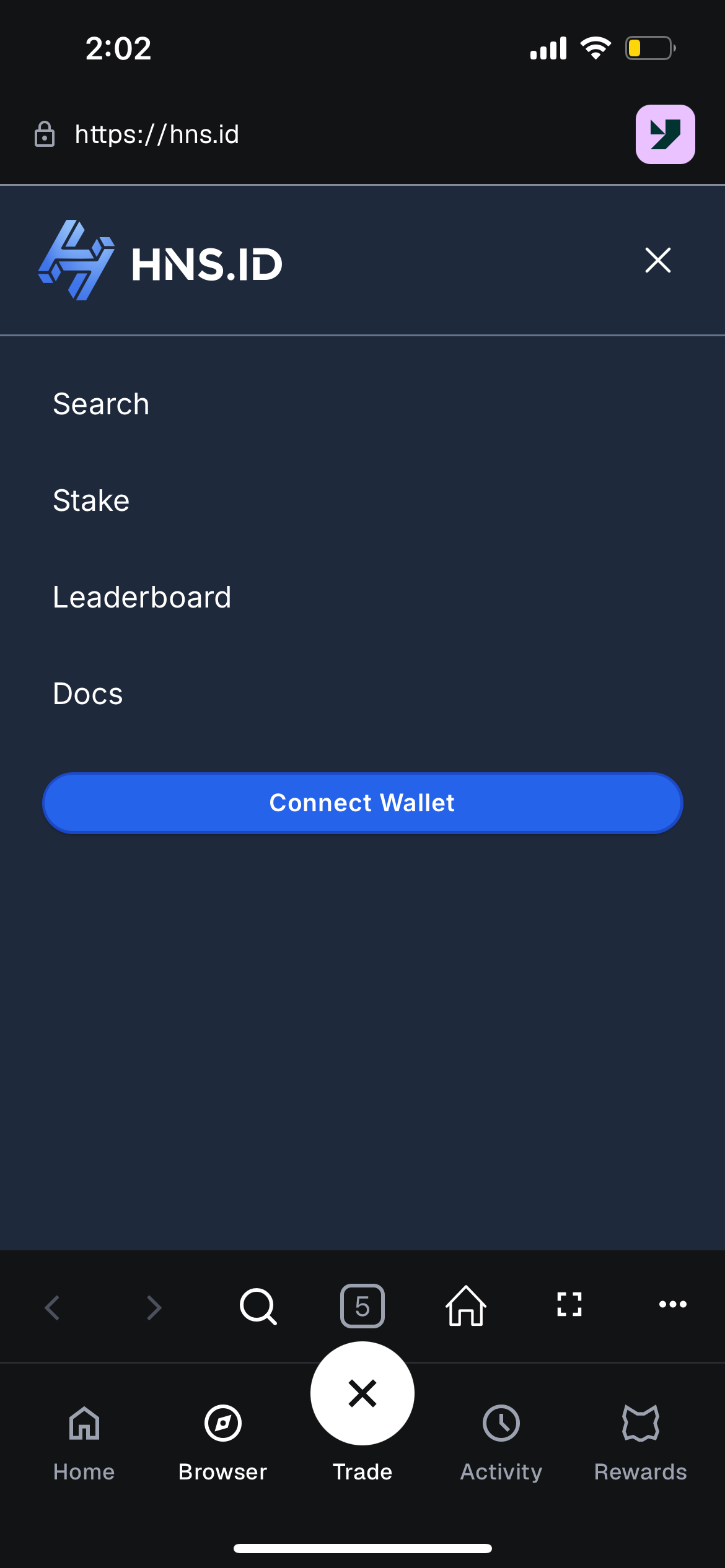
Here's the step-by-step process I followed:
- Visit hns.id on your mobile device or desktop browser
- Tap the menu icon in the top right corner
- Click "Connect Wallet" at the bottom of the menu
- Select MetaMask from the wallet options
- If using mobile, the MetaMask app will open automatically
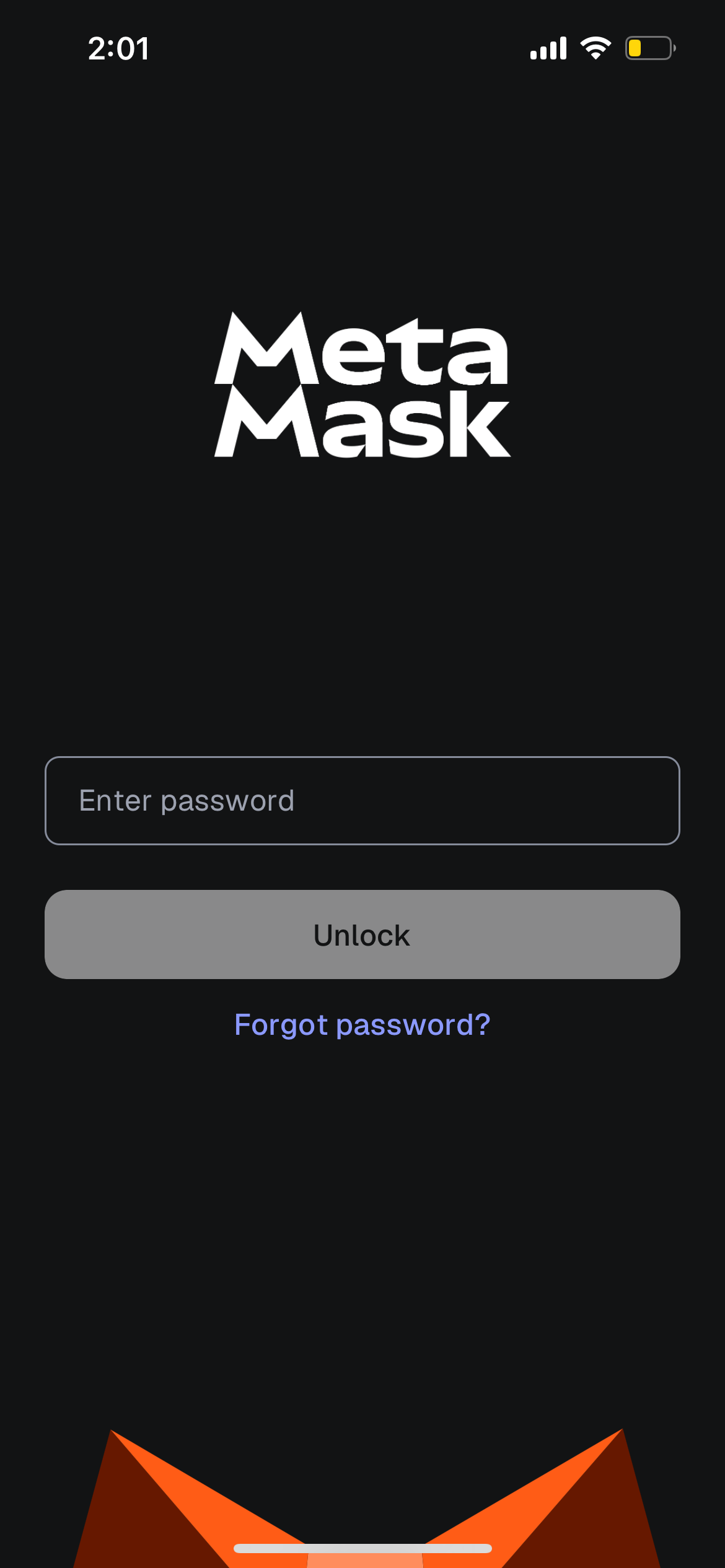
- Enter your MetaMask password to unlock your wallet
- Approve the connection request
- You'll be redirected back to HNS.id with your wallet connected
The connection process took less than 30 seconds. Once connected, your wallet address appears in the interface, and you can start browsing domains.
One thing to note: HNS.id operates on the Polygon network to keep transaction costs low. If you only have ETH on the Ethereum mainnet, you'll need to bridge some funds to Polygon. MetaMask makes this relatively straightforward through their bridge feature, but it does add an extra step for first-time users.
How to Search For and Buy Domains
With my wallet connected, I was ready to explore available domains. The search functionality is straightforward and reminded me of traditional domain registrars, which made the experience less intimidating.
I started by searching for domains related to AI and Web3 themes. Here's what the process looked like:
- Type your desired domain name in the search bar on the homepage
- HNS.id shows you availability across different TLDs (like .wallet, .hns, .uwuai)
- Each TLD shows a starting price, usually ranging from $1 to $10+
- Click on a domain to see full details and purchase options
I purchased two domains for testing: agi.wallet and defai.wallet. Both were available under the .wallet TLD, which seemed fitting for crypto-related projects. The pricing was reasonable—each domain cost around $10-15 for a one-year registration.
The purchase flow was smooth:
- Click "Buy" on your chosen domain
- Select your registration period (1 year, 2 years, etc.)
- Review the total cost in your wallet's currency
- Approve the transaction in MetaMask
- Wait for blockchain confirmation (usually under a minute)
- The domain appears in your "My Domains" dashboard
Gas fees on Polygon were minimal—I paid less than $0.50 per transaction. This is a huge advantage over Ethereum mainnet, where similar transactions could cost $10-50 depending on network congestion.
Managing Domains and Understanding Expiration
After purchasing my domains, I spent time exploring the management dashboard. This is where things get interesting—and where I learned some important lessons about domain maintenance.
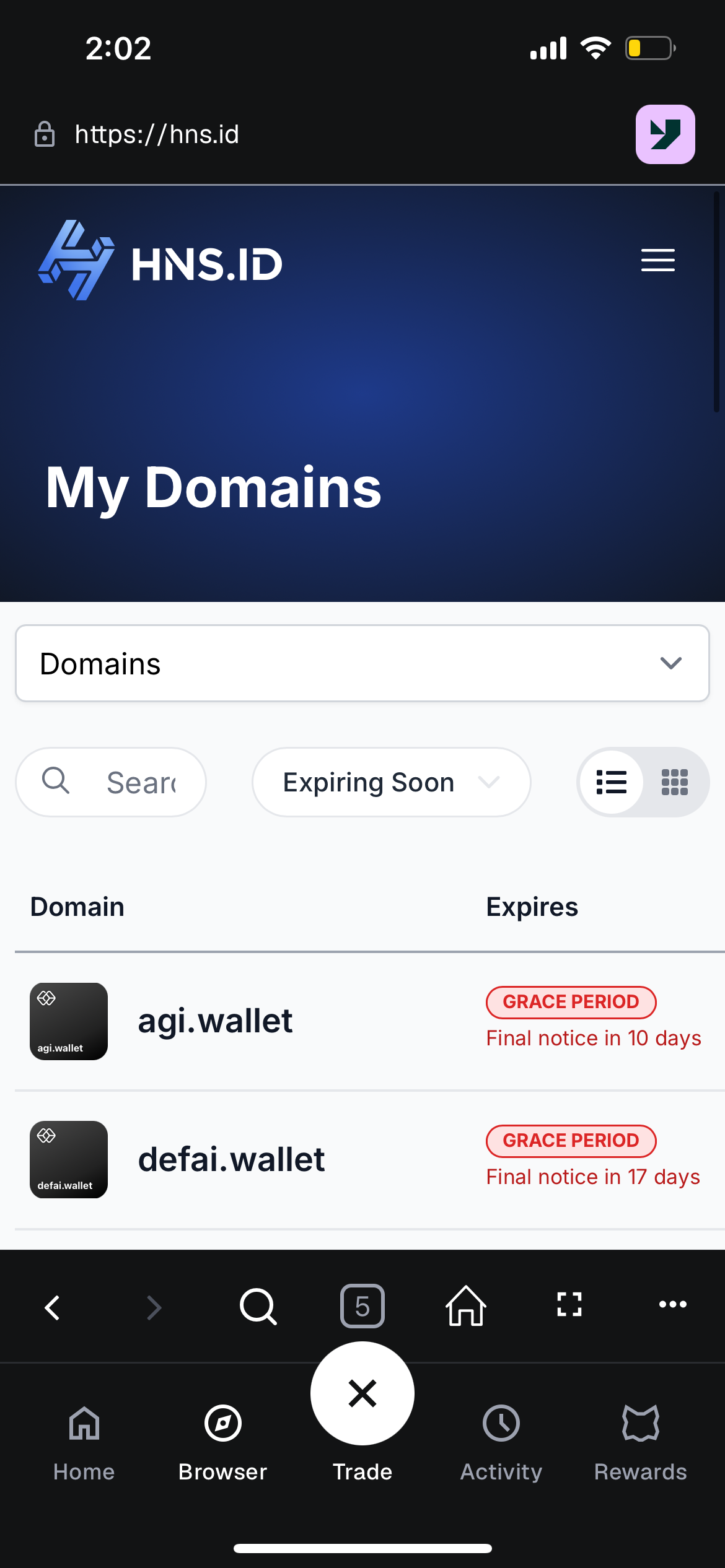
The "My Domains" section shows all your registered domains in a clean list view. For each domain, you can see:
- Domain name and icon
- Expiration status
- Time remaining until expiration
- Quick actions: Renew, Refresh, OpenSea

The Grace Period: A Critical Detail
Here's something I learned the hard way: Handshake domains have a grace period after expiration, but it's not unlimited. When I checked my domains after a few weeks, I saw they were marked "GRACE PERIOD" with a final notice countdown.
For agi.wallet, I had 10 days remaining. For defai.wallet, 17 days. This grace period gives you time to renew before the domain becomes available to others, but you need to pay attention. Unlike traditional domains where registrars send email reminders, decentralized systems put the responsibility entirely on you.
The renewal process is simple:
- Open the domain from your dashboard
- Click the "Renew" button
- Select your renewal period
- Approve the transaction in your wallet
I appreciate that HNS.id makes renewal straightforward, but I do wish there were notifications or alerts when domains are approaching expiration. This is one area where centralized registrars still have an advantage—they're much better at reminding you to renew.
Additional Management Features
Beyond renewal, each domain has a few other management options:
- Refresh: Updates the domain's blockchain state if there are sync issues
- OpenSea: Takes you directly to the domain's OpenSea listing, where you can list it for sale or view trading history
- Records: Configure DNS records, wallet addresses, and other technical settings
The OpenSea integration is clever. Since these domains are NFTs, you can trade them on secondary markets just like any other digital asset. I checked the trading history for similar domains and found an active market with prices ranging from $50 to several thousand dollars for premium names.
Real Example: Using agi.wallet and defai.wallet
Let me walk through my actual experience with these two domains to show what ownership looks like in practice.
agi.wallet — I registered this with the idea of potentially using it for an AI-related crypto project. The name is short, memorable, and clearly signals its purpose. After purchasing, I explored setting it up to resolve to a wallet address, which would let people send crypto to "agi.wallet" instead of a long hex address.
defai.wallet — This one was more speculative. Decentralized finance (DeFi) and AI (AI) are both hot topics, and the combination seemed like it might have value. I haven't built anything with it yet, but I'm holding it as a potential brand name for future projects.
Both domains show up in my MetaMask wallet as NFTs. I can view them in the collectibles section, transfer them to other wallets, or list them for sale. This feels fundamentally different from traditional domains—I truly own these assets in a way that's cryptographically verifiable and transferable without any intermediary's permission.
However, the practical utility is still limited. I can't simply type "agi.wallet" into Chrome and expect it to work. I'd need to set up DNS records, configure resolution services, and potentially ask visitors to use specific browsers or extensions. This is the biggest gap between the promise of decentralized domains and current reality.
Pros and Cons of Using HNS.id
After spending time with the platform, here's my honest assessment of what works and what doesn't.
Pros
- True ownership: Your domains are NFTs in your wallet, not licenses from a registrar
- Low transaction costs: Using Polygon keeps fees under $1 in most cases
- Clean interface: The UI is surprisingly polished for a Web3 app
- Mobile-friendly: Everything works smoothly on mobile browsers and wallets
- Secondary market: Direct OpenSea integration makes trading easy
- Variety of TLDs: Lots of options beyond just .hns
- No KYC: Purchase domains anonymously with just a wallet
Cons
- Limited browser support: Most people can't access Handshake domains without extensions
- No renewal reminders: You're responsible for tracking expiration dates
- Learning curve: Requires understanding wallets, networks, and gas fees
- Early adoption: The ecosystem is small compared to traditional DNS
- Network dependency: Requires Polygon and bridging if you only have ETH
- Grace period stress: Short windows for renewal create pressure
- Practical utility unclear: Hard to actually use these domains for websites yet
The pros outweigh the cons if you're already comfortable with Web3 and see value in censorship-resistant naming. But for the average internet user, the barriers are still significant.
Who Should Consider Using HNS.id Today?
Based on my experience, HNS.id makes sense for specific use cases, not everyone.
Good fit for:
- Web3 developers: If you're building dApps, DeFi projects, or blockchain services, having a decentralized domain aligns with your values and user base
- Crypto enthusiasts: People who already use MetaMask daily and want human-readable wallet addresses
- Domain investors: If you speculate on digital assets, Handshake domains are an emerging market with low entry costs
- Privacy advocates: Anyone wanting censorship-resistant naming for content or services
- Early adopters: If you like experimenting with new technology before mainstream adoption
Not yet ideal for:
- Traditional businesses: If your customers aren't crypto-native, they won't be able to access your Handshake domain easily
- First-time domain buyers: The Web3 complexity makes traditional registrars simpler for now
- Anyone needing immediate utility: These domains are more about future potential than current functionality
- Low-risk tolerance: The technology is still experimental and could face regulatory challenges
I fall into the "early adopter" category. I don't have immediate plans to build websites on these domains, but I'm betting that decentralized naming will become more important as Web3 matures. The low cost of entry ($10-15 per domain) makes it easy to experiment without significant financial risk.
The Future of Decentralized Identity and Domain Ownership
Working with HNS.id made me think about where we're headed with digital identity and ownership. The current internet relies heavily on centralized gatekeepers—companies and organizations that control critical infrastructure like domain names, social media handles, and authentication systems.
Handshake and platforms like HNS.id represent a different vision: one where individuals control their own namespace without asking permission. This matters more as AI systems become prevalent. If AI agents need to reference resources, make transactions, or establish identity, decentralized naming provides a foundation that's resistant to manipulation and censorship.
But we're not there yet. The technology works, but adoption is the challenge. For Handshake domains to succeed, we need:
- Native browser support or widespread resolver adoption
- More intuitive management tools (like automatic renewal reminders)
- Real-world applications that demonstrate value beyond speculation
- Education to help non-technical users understand the benefits
- Integration with existing internet infrastructure
My experience with agi.wallet and defai.wallet showed me that the infrastructure is ready—it works smoothly and the costs are reasonable. What's missing is the ecosystem around it. I can own these domains, but I can't easily use them for anything beyond wallet addresses or speculative investment.
That said, I'm optimistic. The same was true of cryptocurrency ten years ago. Bitcoin worked technically, but practical uses were limited. Now, crypto is integrated into mainstream finance, and the infrastructure has matured dramatically. Decentralized domains may follow a similar path.
For now, HNS.id serves as an accessible entry point into this emerging space. It won't replace traditional domains immediately, but it offers a glimpse of what decentralized identity might look like. If you're curious about Web3, have a few dollars to experiment with, and want to claim your stake in a potential future namespace, it's worth exploring.
Just remember to renew your domains before the grace period expires—I learned that lesson firsthand.