
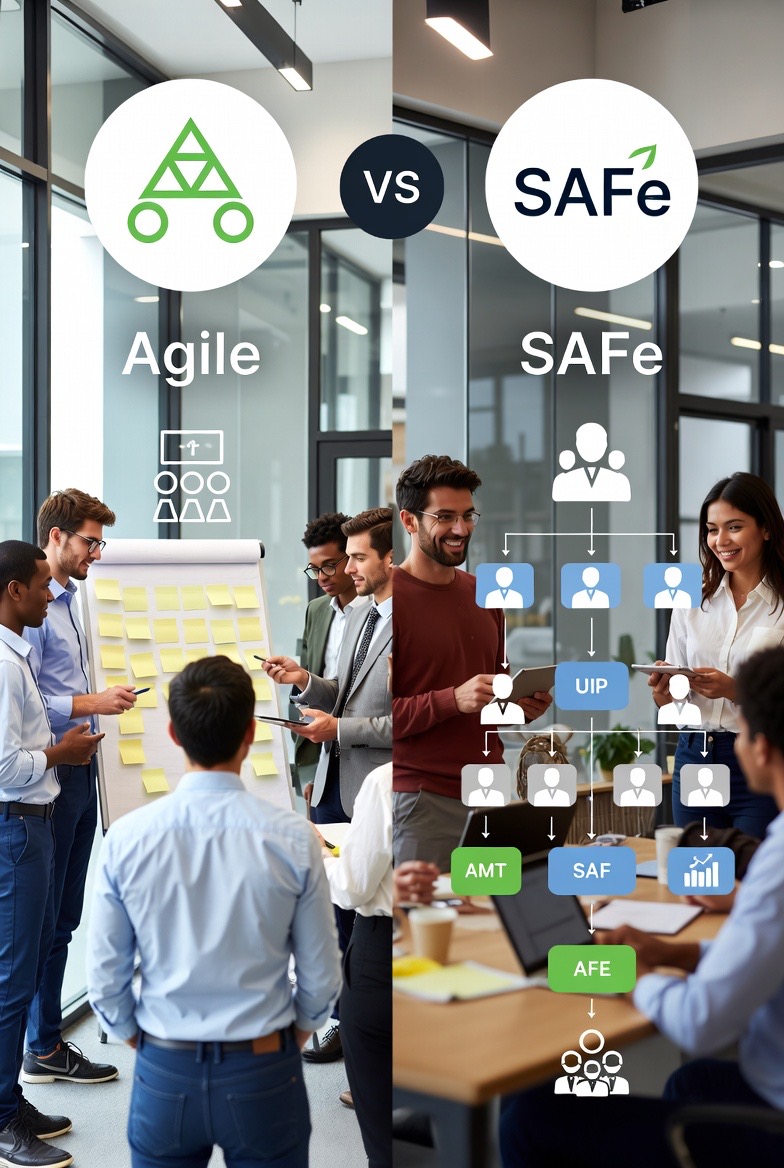
Master the differences between Agile and SAFe methodologies. Learn when to use each framework, implementation strategies, and real-world examples for successful project delivery.
Introduction: The Evolution of Project Management
In today's fast-paced business environment, organizations face a critical challenge: how to deliver value quickly while maintaining quality, managing complexity, and coordinating across multiple teams. Traditional waterfall project management, with its rigid phases and lengthy planning cycles, increasingly fails to meet modern demands for agility and rapid iteration.
Enter Agile and SAFe—two powerful frameworks that have revolutionized how organizations approach project and product development. While Agile transformed small team dynamics and software development practices, SAFe emerged to address the challenge of scaling these principles across entire enterprises with hundreds or thousands of team members.
This comprehensive guide will help you understand both frameworks, their strengths and limitations, and most importantly—how to choose the right approach for your specific organizational context.
Understanding Agile Methodology
What is Agile?
Agile is a project management and product development philosophy that emphasizes flexibility, collaboration, customer feedback, and rapid iteration. Born from the 2001 Agile Manifesto, it represents a fundamental shift from traditional command-and-control project management to adaptive, team-empowered delivery.
The Four Core Values of Agile
The Agile Manifesto established four key values:
- Individuals and interactions over processes and tools
- Working software over comprehensive documentation
- Customer collaboration over contract negotiation
- Responding to change over following a plan
This doesn't mean the items on the right have no value—rather, Agile prioritizes the items on the left as more critical to success.
The Twelve Agile Principles
Beyond the four values, twelve principles guide Agile implementation:
- Customer satisfaction through early and continuous delivery
- Welcome changing requirements, even late in development
- Deliver working software frequently (weeks rather than months)
- Business people and developers work together daily
- Build projects around motivated individuals
- Face-to-face conversation is the most effective communication method
- Working software is the primary measure of progress
- Sustainable development—maintain a constant pace indefinitely
- Continuous attention to technical excellence and good design
- Simplicity—maximize the work not done
- Self-organizing teams produce the best architectures and designs
- Regular reflection and adjustment of team behavior
Popular Agile Frameworks
Scrum
The most widely adopted Agile framework, Scrum organizes work into fixed-length iterations called sprints (typically 2-4 weeks). Key elements include:
- Roles: Product Owner, Scrum Master, Development Team
- Ceremonies: Sprint Planning, Daily Standup, Sprint Review, Sprint Retrospective
- Artifacts: Product Backlog, Sprint Backlog, Increment
Kanban
Emphasizes continuous flow and work-in-progress limits. Kanban visualizes work on a board with columns representing workflow stages. Teams pull work as capacity allows rather than committing to fixed iterations.
Extreme Programming (XP)
Focuses on technical practices for software quality, including pair programming, test-driven development, continuous integration, and frequent releases.
Scrumban
Combines Scrum's structured ceremonies with Kanban's flow-based approach, offering flexibility while maintaining regular planning and retrospective cycles.
Benefits of Agile
- Faster Time to Market: Incremental delivery means value reaches customers sooner
- Higher Quality: Continuous testing and integration catch defects early
- Better Risk Management: Regular inspection points identify issues quickly
- Improved Customer Satisfaction: Frequent feedback ensures alignment with needs
- Team Empowerment: Self-organizing teams make better decisions
- Adaptability: Easy to adjust course based on new information
- Transparency: Daily standups and visible boards create clarity
Limitations of Traditional Agile
While powerful for small teams, traditional Agile faces challenges at scale:
- Coordination Complexity: Multiple teams working on interdependent features struggle to stay aligned
- Architectural Inconsistency: Each team making independent decisions can create technical debt
- Resource Allocation: Portfolio-level planning becomes difficult with autonomous teams
- Stakeholder Management: Enterprise leadership needs visibility beyond individual team progress
- Compliance and Governance: Regulated industries require structured approaches to documentation and approvals
- Budget Planning: Financial departments need longer-term forecasts than sprint-by-sprint planning provides
Understanding SAFe (Scaled Agile Framework)
What is SAFe?
SAFe is a comprehensive framework for implementing Agile practices at enterprise scale. Developed by Dean Leffingwell and first released in 2011, SAFe provides structured guidance for coordinating multiple Agile teams working on large, complex solutions. It combines Agile development, lean product development, systems thinking, and DevOps principles.
SAFe addresses the question: "How do we scale Agile benefits across an entire organization with hundreds of people working on interconnected products and platforms?"
SAFe Core Values
SAFe is built on four core values:
- Alignment: Ensure all teams work toward common objectives
- Built-in Quality: Quality is not negotiable—build it in at every step
- Transparency: Trust thrives when everyone can see the real state of work
- Program Execution: Value delivery requires relentless focus on execution
SAFe Configuration Levels
SAFe offers four configurations to fit organizational size and complexity:
1. Essential SAFe
The minimal implementation, Essential SAFe includes one Agile Release Train (ART)—typically 50-125 people organized into 5-12 Agile teams. This level provides:
- Program Increment (PI) Planning every 8-12 weeks
- Agile teams using Scrum, Kanban, or XP
- Product Management and System Architecture roles
- DevOps and Release on Demand
2. Large Solution SAFe
For organizations building large, complex solutions requiring multiple ARTs to coordinate. Adds:
- Solution Train—coordinates multiple ARTs
- Solution Management roles
- Pre- and Post-PI Planning for cross-ART coordination
- Supplier integration processes
3. Portfolio SAFe
Connects strategy to execution by adding portfolio-level governance. Includes:
- Lean Portfolio Management
- Strategic Themes and Portfolio Vision
- Value Stream identification and funding
- Epic ownership and governance
- Lean budgeting practices
4. Full SAFe
The complete framework combining all three levels—suitable for the largest, most complex organizations managing multiple solution trains across a portfolio.
Key SAFe Concepts
Agile Release Train (ART)
The primary organizational construct in SAFe, an ART is a long-lived team of Agile teams (typically 5-12 teams, 50-125 people) that plans, commits, and executes together. ARTs deliver value in fixed Program Increments.
Program Increment (PI)
A timebox of 8-12 weeks during which an ART delivers incremental value through tested, working systems. Each PI begins with PI Planning and ends with an Inspect and Adapt workshop.
PI Planning
A critical two-day event where all ART members gather to align on objectives, identify dependencies, and commit to specific outcomes for the upcoming PI. This face-to-face (or virtual) planning is essential for coordination.
Value Streams
The series of steps an organization uses to deliver value to customers. SAFe organizes around value streams rather than functional silos, ensuring flow from concept to cash.
System Demo
Every two weeks, the entire ART demonstrates integrated, working functionality to stakeholders. This maintains transparency and enables fast feedback.
Inspect and Adapt (I&A)
At the end of each PI, the ART holds a structured problem-solving workshop to identify and address systemic issues. This drives continuous improvement at scale.
SAFe Roles and Responsibilities
Team Level
- Agile Team: 5-11 cross-functional members delivering value
- Product Owner: Defines and prioritizes team backlog
- Scrum Master: Coaches team and removes impediments
Program Level
- Release Train Engineer (RTE): Servant leader and coach for the ART
- Product Management: Defines and prioritizes program backlog
- System Architect: Defines technical vision and roadmap
- Business Owners: Key stakeholders accountable for ROI
Portfolio Level
- Epic Owners: Drive significant initiatives from concept through implementation
- Enterprise Architect: Promotes adaptive technology design
- Lean Portfolio Management: Oversees value stream funding and governance
Benefits of SAFe
- Enterprise-Scale Coordination: Align hundreds of people toward common goals
- Predictable Delivery: PI cadence enables reliable planning and forecasting
- Strategic Alignment: Connect portfolio strategy directly to execution
- Risk Reduction: Regular integration and demos surface issues early
- Quality at Scale: Built-in quality practices prevent technical debt accumulation
- Faster Learning: Structured inspect-and-adapt cycles drive improvement
- Better Visibility: Executives gain clear line-of-sight to value delivery
- Cultural Transformation: Comprehensive change management supports adoption
Criticisms of SAFe
SAFe is not without controversy in the Agile community:
- Complexity: Critics argue SAFe is too prescriptive and bureaucratic
- Heavy Process: Some see it as "waterfall in Agile clothing"
- Top-Down Nature: Contradicts Agile principles of team empowerment
- Certification Focus: Concerns about commercialization over genuine transformation
- Cultural Fit: May not align with truly autonomous, self-organizing cultures
- Implementation Overhead: Requires significant organizational commitment and change
When to Use Agile (Without SAFe)
Ideal Scenarios for Traditional Agile
1. Small to Medium Teams (1-3 Teams)
When your entire effort involves fewer than 30-40 people, traditional Agile frameworks like Scrum or Kanban provide all the structure you need without additional overhead. Three co-located teams can coordinate informally through Scrum-of-Scrums and regular communication.
Example: A startup building a mobile app with two development teams, one design team, and supporting functions. Simple daily coordination keeps everyone aligned.
2. Simple, Bounded Products
When building a product with clear boundaries, minimal external dependencies, and straightforward architecture, traditional Agile enables maximum team autonomy and speed.
Example: A marketing website, internal tool, or standalone mobile application that doesn't integrate extensively with complex enterprise systems.
3. High Autonomy Cultures
Organizations with mature, self-organizing teams that communicate effectively without formal coordination mechanisms thrive with minimal process. If your culture genuinely supports empowerment and teams naturally collaborate, keep it simple.
Example: A technology company like Spotify (historically) or GitHub where engineering culture emphasizes autonomy, with teams that naturally coordinate through technical practices and open communication.
4. Research and Innovation Projects
Highly exploratory work with uncertain outcomes benefits from maximum flexibility. The lightweight nature of Agile allows rapid pivots without the overhead of large-scale planning events.
Example: An innovation lab exploring new AI capabilities, prototyping potential products, or researching emerging technologies. Direction changes frequently based on discoveries.
5. Consultant or Agency Work
When building discrete deliverables for external clients with separate contracts, traditional Agile provides appropriate governance without the enterprise-scale machinery of SAFe.
Example: A digital agency building custom websites, applications, or campaigns for multiple clients simultaneously. Each project team operates independently with its own backlog and stakeholders.
6. Non-Software Applications
Marketing teams, HR departments, or operational groups applying Agile principles to their work benefit from simple frameworks without software development's complexity and scale challenges.
Example: A marketing team using Kanban to manage campaign development, or an HR team using Scrum to roll out new policies and programs.
Organizational Characteristics Favoring Traditional Agile
- Flat organizational structure
- Strong culture of direct communication
- Limited regulatory compliance requirements
- Co-located or closely distributed teams
- Product-focused rather than project-focused
- Tolerance for minimal documentation
- Quick decision-making capability
- Limited need for long-term financial forecasting
When to Use SAFe
Ideal Scenarios for SAFe
1. Large-Scale Software Development (50+ People)
When multiple teams must coordinate to deliver a cohesive product or platform, SAFe's structured approach prevents chaos. Once you exceed 3-4 teams, informal coordination breaks down and you need formal mechanisms for alignment.
Example: An enterprise building a comprehensive cloud platform with teams handling infrastructure, security, APIs, user interfaces, mobile apps, and DevOps—all interdependent and requiring tight coordination.
2. Multiple Interdependent Products
When your organization maintains a product suite or ecosystem where changes in one product affect others, SAFe's program-level planning ensures everyone stays aligned.
Example: A financial services company offering banking, investment, insurance, and payment products that share common customer data, authentication systems, and regulatory requirements.
3. Hardware-Software Integration
Physical product development requires longer lead times and more coordination than pure software. SAFe's PI planning accommodates hardware development cycles while maintaining Agile benefits for software components.
Example: An automotive company developing connected vehicles with teams handling mechanical engineering, electronics, embedded software, cloud services, and mobile applications.
4. Highly Regulated Industries
Healthcare, aerospace, financial services, and other regulated sectors need structured documentation, traceability, and governance. SAFe provides compliance-friendly practices while maintaining agility.
Example: A medical device manufacturer needing FDA approval must demonstrate rigorous development processes, change control, and validation—all addressed in SAFe's compliance extensions.
5. Distributed Global Teams
When teams span multiple time zones and locations, the structured rhythms of SAFe (PI Planning, System Demos, I&A events) create essential synchronization points that informal coordination cannot achieve.
Example: A multinational corporation with development centers in India, Poland, California, and New York working on the same platform requires formal coordination mechanisms to stay aligned.
6. Portfolio Management Needs
Organizations managing multiple value streams and needing to allocate resources across competing priorities benefit from SAFe's portfolio-level governance, enabling strategic decision-making about where to invest.
Example: A technology company running ten different product lines with shared engineering resources needs visibility across all initiatives to make smart investment decisions.
7. Budget and Forecast Requirements
When finance departments need predictable quarterly or annual forecasts, SAFe's PI planning and roadmapping provide the planning horizon traditional Agile lacks.
Example: Public companies needing to report progress against committed roadmaps to investors and analysts benefit from SAFe's structured planning and predictable delivery cadence.
8. Legacy System Modernization
Transforming large, complex legacy systems while maintaining operational stability requires the coordination and architectural governance SAFe provides.
Example: A bank modernizing its 30-year-old core banking system while continuing to serve millions of customers needs careful orchestration across architecture, migration, testing, and operations teams.
Organizational Characteristics Favoring SAFe
- More than 50 people working on related initiatives
- Multiple interdependent systems or products
- Significant architectural complexity
- Regulatory compliance requirements
- Need for executive visibility and governance
- Multi-year roadmaps and commitments
- Distributed teams across time zones
- Formal budget planning cycles
- Risk-averse culture requiring structure
- Existing project management infrastructure to leverage
Hybrid Approaches: Finding the Middle Ground
The binary choice between pure Agile and full SAFe represents a false dichotomy. Many organizations successfully adopt hybrid approaches:
Agile with Light Coordination
Implement traditional Agile at the team level while adding minimal coordination practices:
- Scrum of Scrums for cross-team alignment
- Quarterly planning sessions (lighter than PI Planning)
- Regular architecture reviews
- Shared backlogs for interdependent work
Best for: 4-6 teams (30-60 people) with moderate interdependencies
Essential SAFe Only
Adopt Essential SAFe (one ART) without portfolio or solution layers. This provides structured program-level coordination without enterprise-scale overhead.
Best for: 5-12 teams (50-125 people) working on a single product or platform
SAFe-Inspired Practices
Cherry-pick SAFe elements that solve specific problems:
- Borrow PI Planning format for quarterly alignment
- Implement System Demos for integration visibility
- Use Inspect and Adapt workshops for structured improvement
- Adopt weighted shortest job first (WSJF) for prioritization
Best for: Organizations wanting specific SAFe benefits without full transformation
Discipline-Specific Scaling
Apply SAFe to development teams while keeping other functions (marketing, sales, support) in traditional Agile or even non-Agile approaches.
Best for: Software development organizations where scale challenges exist primarily in engineering
Implementation Strategies
Successfully Implementing Traditional Agile
Start with Training
Ensure everyone understands Agile values and principles, not just practices. Certification courses (Certified Scrum Master, Professional Scrum Master) provide foundational knowledge.
Begin with One Team
Don't transform everything at once. Start with a pilot team, learn from experience, then expand. Choose a team with:
- Strong product ownership
- Receptive culture
- Reasonable complexity
- Supportive leadership
Hire Experienced Coaches
External Agile coaches accelerate learning and prevent common pitfalls. Budget for coaching through the first 6-12 months.
Focus on Outcomes, Not Rituals
Don't just "do Agile"—achieve Agile outcomes: faster delivery, higher quality, better collaboration. Adapt practices to your context rather than following dogma.
Invest in Technical Excellence
Agile requires strong technical practices: automated testing, continuous integration, refactoring discipline. Without these, velocity collapses under technical debt.
Successfully Implementing SAFe
Get Leadership Commitment
SAFe transformation requires executive sponsorship, budget allocation, and patience for culture change. Half-hearted adoption fails. Leaders must:
- Participate in training
- Attend PI Planning events
- Remove organizational impediments
- Model new behaviors
Start with Essential SAFe
Don't implement the entire framework at once. Begin with one Agile Release Train (Essential SAFe configuration), prove value, then expand.
Identify Your First Value Stream
Choose carefully. Your first ART should:
- Deliver clear business value
- Have supportive leadership
- Include 50-125 people
- Not be your most critical system initially
- Have manageable complexity
Train Everyone
SAFe requires role-based training for everyone involved:
- Leading SAFe for executives and managers
- SAFe Scrum Master certification
- SAFe Product Owner/Product Manager training
- SAFe for Teams for individual contributors
- Release Train Engineer certification for RTEs
Plan Your First PI
The first PI Planning event is crucial. Invest in proper facilitation:
- Secure appropriate venue (or virtual platform)
- Prepare vision and context presentations
- Create draft backlogs
- Brief all participants on format and expectations
- Have experienced facilitators present
Establish Communities of Practice
Create cross-team groups for shared learning:
- Scrum Master community
- Product Owner community
- Architecture community
- DevOps community
Measure and Adapt
Track key metrics to demonstrate progress:
- Program Predictability Measure (did we deliver committed objectives?)
- Velocity trends
- Quality metrics (defect rates, technical debt)
- Employee satisfaction
- Time to market
Decision Framework: Choosing Your Approach
Use this decision tree to determine the right framework:
Question 1: How Many People?
- 1-25 people: Traditional Agile (single team or 2-3 teams)
- 25-50 people: Agile with light coordination
- 50-125 people: Consider Essential SAFe
- 125+ people: SAFe (possibly Large Solution or Portfolio)
Question 2: How Interdependent Is the Work?
- Low interdependency: Traditional Agile with separate backlogs
- Moderate interdependency: Agile with coordination mechanisms
- High interdependency: SAFe with program-level planning
Question 3: What's Your Organizational Culture?
- High autonomy, trust-based: Traditional Agile
- Moderate structure, maturing: Hybrid approach
- Formal, process-oriented: SAFe provides needed structure
Question 4: Regulatory Requirements?
- Minimal: Traditional Agile sufficient
- Moderate: Agile with enhanced documentation
- Heavy (FDA, SOX, GDPR, etc.): SAFe provides compliance framework
Question 5: Geographic Distribution?
- Single location/time zone: Traditional Agile
- 2-3 locations: Agile with strong tooling and communication
- Global distribution: SAFe's structured synchronization helps
Question 6: Executive Visibility Needs?
- Low (trust teams): Traditional Agile
- Moderate: Agile with regular demos and reporting
- High (public company, board requirements): SAFe provides governance
Common Pitfalls and How to Avoid Them
Agile Pitfalls
1. Agile in Name Only
Problem: Teams adopt Agile ceremonies without embracing values—just "waterfall with standups."
Solution: Focus on outcomes (faster delivery, higher quality, better collaboration) not just process compliance. Regularly assess whether you're achieving Agile benefits.
2. Absent Product Owners
Problem: Product Owners lack time or authority, becoming backlog administrators rather than decision-makers.
Solution: Ensure Product Owners are empowered, available, and accountable. They should spend 50%+ of time with their team.
3. Neglecting Technical Practices
Problem: Teams focus on process but ignore technical excellence—automated testing, CI/CD, refactoring.
Solution: Invest equally in technical practices. Consider XP practices even if using Scrum. Technical debt will kill velocity without discipline.
4. Skipping Retrospectives
Problem: Teams skip retros when busy, preventing continuous improvement.
Solution: Protect retrospectives religiously. They're your primary improvement mechanism. Never skip them.
SAFe Pitfalls
1. Too Much, Too Fast
Problem: Implementing Full SAFe across the entire organization simultaneously overwhelms people and guarantees failure.
Solution: Start with Essential SAFe and one ART. Prove value, learn lessons, then expand deliberately.
2. Ignoring Culture
Problem: Treating SAFe as purely a process change rather than cultural transformation.
Solution: Invest in change management, leadership development, and culture initiatives alongside process changes.
3. Checkbox Compliance
Problem: Following SAFe prescriptions mechanically without understanding purpose or adapting to context.
Solution: Understand the "why" behind every practice. Adapt intelligently to your specific context while preserving core principles.
4. Weak Release Train Engineers
Problem: Appointing project managers as RTEs without proper training or servant-leader mindset.
Solution: Select RTEs carefully. They need facilitation skills, technical credibility, and genuine commitment to servant leadership. Invest in their development.
5. Virtual PI Planning Done Poorly
Problem: Remote PI Planning becomes a series of boring presentations rather than collaborative planning.
Solution: Use excellent tools (Miro, Mural, etc.), keep breakout rooms small, ensure strong facilitation, and maintain energy through varied activities.
Real-World Case Studies
Success with Traditional Agile: Spotify
Spotify famously developed its own Agile model (Squads, Tribes, Chapters, Guilds) based on traditional Agile principles scaled through culture rather than process. With autonomous teams and strong engineering practices, they achieved rapid innovation without formal frameworks like SAFe.
Key Success Factors: High-trust culture, strong technical practices, clear mission alignment, excellent hiring
Success with SAFe: John Deere
John Deere transformed its embedded software development using SAFe, coordinating hundreds of engineers across hardware and software teams. They achieved 50% faster time-to-market and significantly improved quality for their smart equipment systems.
Key Success Factors: Executive commitment, comprehensive training, patience through transformation, focus on built-in quality
Success with Hybrid Approach: ING Bank
ING Netherlands restructured around customer-centric squads using Agile principles while maintaining coordination mechanisms inspired by SAFe (tribes, chapters). They avoided full SAFe but borrowed its scaling concepts.
Key Success Factors: Bold organizational redesign, customer focus, willingness to adapt frameworks to fit their context
The Future of Agile and SAFe
Emerging Trends
Business Agility Beyond IT
Agile principles expanding to HR, finance, marketing, and operations. SAFe 6.0 explicitly addresses business agility across entire enterprises.
Product Operating Model
Shift from project funding to product funding, with persistent teams and continuous funding rather than temporary project teams.
Flow Metrics
Moving beyond velocity to flow efficiency, cycle time, and value delivery metrics that better reflect customer outcomes.
AI-Assisted Planning
Machine learning tools helping with estimation, dependency mapping, and risk identification in both Agile and SAFe contexts.
Remote-First Practices
Post-pandemic evolution of both frameworks to work effectively in distributed-first environments rather than treating remote as a compromise.
Conclusion: Making the Right Choice
The choice between Agile and SAFe isn't about which framework is "better"—it's about which approach fits your organizational context, scale, and maturity level.
Choose traditional Agile when: You have small teams (under 50 people), limited interdependencies, high-trust culture, and straightforward products. Keep it simple and empower teams maximally.
Choose SAFe when: You're coordinating 50+ people, managing complex interdependencies, operating in regulated industries, or need enterprise-level governance and visibility. Accept the additional structure as necessary scaffolding for coordination at scale.
Consider hybrid approaches when: You fall between these extremes. Borrow practices from both, adapt to your context, and evolve your approach based on what works.
Most importantly, remember that frameworks are means to an end, not the end itself. The goal is delivering value to customers faster, with higher quality, and with happier teams. Whether you achieve that through Scrum, SAFe, or something entirely custom matters far less than actually achieving it.
Start where you are, use what works, and continuously improve. That's the most Agile approach of all.
Key Takeaways
- Agile excels for small teams (under 50 people) with straightforward products and high-autonomy cultures
- SAFe provides necessary structure for coordinating 50+ people across interdependent systems
- The decision depends on team size, interdependency, culture, compliance needs, and distribution
- Hybrid approaches combining elements of both frameworks work well for mid-sized organizations
- Both frameworks require genuine cultural change, not just process adoption
- Start small with either approach—one team for Agile, one ART for SAFe
- Focus on outcomes (faster delivery, higher quality) not just following prescribed practices
- Technical excellence is non-negotiable for sustainable success with either framework
- Executive commitment and proper training are essential for SAFe success
- Continuously adapt your approach based on results and changing context
The right framework is the one that helps your organization deliver value effectively. Choose wisely, implement thoughtfully, and improve continuously.